

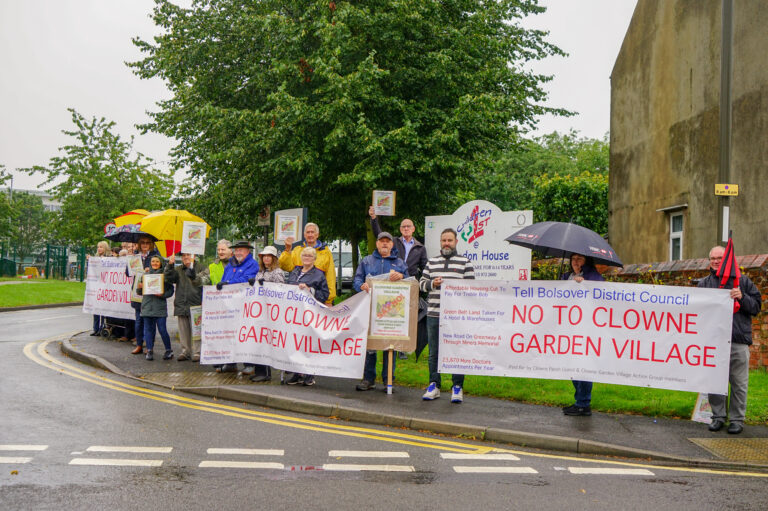
Report by Local Democracy Reporter – Jon Cooper
A determined campaigner who fought tooth and nail during a long-running dispute to try and stop the controversial Clowne Garden Village housing scheme for 1,800 homes has finally failed in his last ditch bid to at least guarantee around £1.5m of SEND funding from the developer.
Bolsover District Council originally granted outline planning permission for Waystone Ltd’s application for the Clowne Garden Village housing scheme for 1,800 homes near Clowne and Barlborough, in September, 2024, after it also agreed arrangements for financial infrastructure contributions worth millions of pounds to be paid by the developer.
But the scheme’s progress was stalled after campaigner Dom Webb submitted a request to one of the highest courts in the land – the Court of Appeal in London – for permission to lodge an appeal after a request for a judicial review into the scheme was refused and his initial appeal to apply for a judicial review was also over-ruled by a judge in April.
However, Mr Webb’s latest eleventh hour bid for permission to further appeal the decision was refused on September 22 after he raised concerns about equality implications and contested that the council had allowed for ‘£1.5m’ of SEND funding from the developer to be reviewed at a later stage depending on the scheme’s viability.
Clowne Garden Village Action Group Chairperson, Mr Webb, said: “Obviously this is disappointing, but I want to thank everyone who has supported the legal action including Clowne and Barlborough Parish Councils, Clowne Community Association, the thousands who signed the petitions, the many individuals who showed up, elected members from all political parties and obviously our legal team at Leigh Day and Landmark Chambers.
“There are no victors in today’s court judgement. Nobody can claim victory for being on the winning side that denies SEND funding to children when 1,800 houses are to be built and the system says this is not critical.
“However, if we are to respect the court’s ruling, which we must, then we should also be gracious in accepting that the council and its officers discharged their obligations and jobs within the bounds of the law and that should be acknowledged, with candour, after such a hard fought and at times fractious battle.
“The planning system in this country is not fit for purpose and clearly needs reform. It creates perverse outcomes every day that make no sense to thousands of communities impacted by the lack of proper investment in their infrastructure and refusal to protect their heritage and wildlife in a meaningful way.”
Mr Webb argued throughout against council agreements to postpone financial contributions, amounting to nearly £1.5m, from the developer for youngsters with Special Educational Needs and Disabilities subject to the developer and scheme’s viability, and that the equality implications of the council’s decision had not been fully considered.
He claimed there were errors relating to the postponed SEND contributions and equality implications. Mr Webb also argued that his case has clearly been about protecting the most vulnerable people in society, the environment and wildlife.
The council’s S106 arrangements included an agreement to defer a £1,463,597 payment from developer Waystone towards helping young people with SEND depending on the scheme’s future viability, and this agreed leeway for the developer has always lied at the heart of Mr Webb’s call and appeals for a judicial review.
Mr Webb’s alleged grounds for a judicial review always included the council’s decision to postpone contributions for youngsters with SEND from the developer pending a viability review and he claimed the council had wrongly allowed the developer to delay making a payment to Derbyshire County Council for SEND provisions.
Other grounds included alleged failures to recognise the impact on wildlife habitat and the environment, and an alleged failed assessment of the impact on archaeology and heritage.
But a judge initially dismissed Mr Webb’s concerns relating to the council’s decision to defer Waystone’s financial contributions over viability.
The same judge also felt that the equality implications and the impact to protected species had been considered, and that there was no need to assess the cumulative impact of the Clowne Garden Village scheme alongside a separate proposed nearby water park scheme.
However, Mr Webb’s legal team filed an initial appeal arguing the judge had not fully addressed the equality implications of the council’s decision to defer the developer’s financial contributions on the grounds of Waystone’s viability concerns.
He also argued the equality implications and the impact on protected species were not fully addressed and properly considered, and that there was a failure to assess the cumulative impact of Clowne Garden Village and the nearby, separate, proposed water park scheme at Whitwell Common, as well as the need to mitigate against climate change.
Mr Webb also argued there were significant gaps in the environmental assessment process of the planning application.
Further claims included the need to consider the scheme’s impact from greenhouse gas emissions from construction, the cumulative environmental effects of the housing and other infrastructure, and the need for a further assessment of the impact on archaeology and heritage.
But The Honourable Mr Justice Mould ruled in April that claimant Mr Webb’s appeal for permission to apply for a judicial review should be refused on all grounds.
However, Mr Webb requested permission from the Court of Appeal to further appeal based on what he regarded as unresolved matters concerning the council’s arrangements for the SEND contributions and the equality implications related to this decision.
But The Right Honourable Lord Justice Newey stated on September 22 that Mr Webb’s appeal would have no real prospect of success and ruled that his permission to further appeal be refused.
Lord Newey had considered that Mr Webb had contended that a judge had ‘erred in law’ in his approach to the public sector equality duty in relation to the SEND matter.
But Lord Newey found that the judge had been justified in refusing permission for a judicial review after considering the public sector equality duty.
Lord Newey also considered that the deferral of any payment in relation to public sector equality duty would not in fact negatively impact on the provision of SEND services being provided by the county council.
The Clowne Garden Village scheme site lies across 24 hectares of greenfield land and features plans for 1,800 homes, employment, community and commercial developments, green infrastructure, educational and recreational elements, a retirement village, a neighbourhood centre, a hotel, restaurant and health care and leisure uses.
Many hundreds of residents and campaigners raised objections amid fears the scheme will lead to overcrowding, place a strain on highways, health services and education, create drainage and flooding problems and affect the countryside and wildlife with the loss of some Green Belt land.
Council Leader, Cllr Jane Yates, had previously said Mr Webb’s failed initial appeal had reinforced the soundness of the council’s original decision and that the housing scheme will support the delivery of growth which she added is important for the district.
The council has also always stated that it has met its duties under the environmental impact assessment regulations and that it has been cooperating fully with relevant interested parties and it is committed to transparency.
Waystone has claimed the housing scheme will support the need for housing and it will bring highway improvements and it will offer potential for economic growth, facilities and jobs.
Bolsover District Council’s Chief Executive, Karen Hanson, said: “The council welcomes the Court of Appeal’s decision, which brings this legal challenge to a close and confirms that the council acted lawfully and appropriately in determining this planning application.
“The council carefully considered all relevant issues before granting planning permission, including the arrangements for SEND funding, and was satisfied that the proposed approach complied with its statutory obligations.
“The council remains committed to securing sustainable growth that delivers much-needed homes and employment opportunities, strengthens local communities and provides the infrastructure, services and facilities necessary to support them, whilst ensuring development is consistent with local and national planning policy.”