

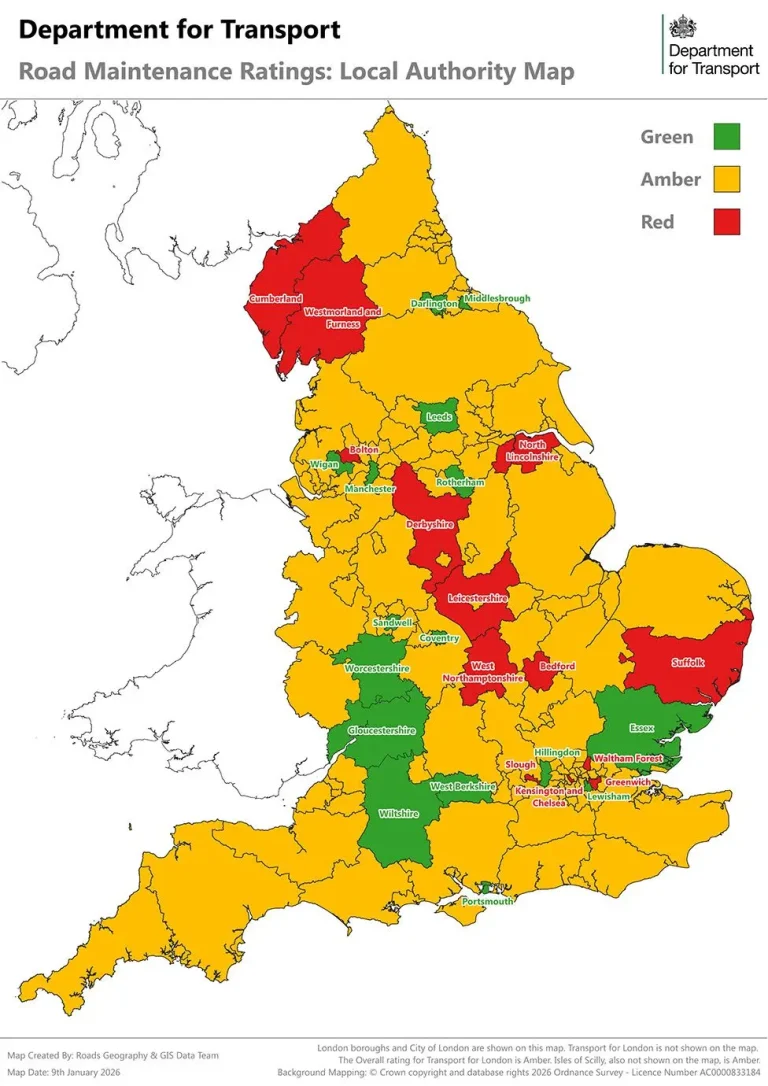
 Drivers across England will soon be able to see how well their local council is tackling potholes, after the government launched a new interactive map and traffic-light rating system for road maintenance.
The Department for Transport (DfT) has rated 154 local highway authorities as green, amber or red, based on the condition of their roads and how effectively they use government funding. Derbyshire is among 13 councils given a red rating, placing it at the bottom of the national table alongside areas including Cumberland, Bolton, Kensington and Chelsea, Bedford, West Northamptonshire and North Lincolnshire.
By contrast, councils such as Essex, Wiltshire, Coventry, Leeds and Darlington were awarded green ratings, indicating stronger performance in maintaining road conditions and delivering value for money.
Transport Secretary Heidi Alexander said motorists had been left to suffer for too long, telling the BBC that people were “fed up of driving to work and hitting the same pothole day after day”. She said drivers were being forced into “needless trips to the garage”, costing them hundreds of pounds.
Alexander said the government’s new mapping tool would allow the public to see how money is being spent locally, adding: “It’s absolutely vital that the public has a mechanism to see what is happening with that money.” The government committed £7.3 billion in November’s Budget to fix roads over the next four years.
Most councils were given an amber rating, meaning they are carrying out repairs and preventative work, but still have room for improvement. Derbyshire, once labelled the “pothole capital of the UK”, recorded the lowest score nationally for road maintenance.
Figures from the RAC show Derbyshire saw the biggest rise in pothole compensation claims between 2021 and 2024. However, Derbyshire County Council says the number of claims has fallen by 72% since May 2025, according to cabinet member for potholes, highways and transport Charlotte Hill.
Councils rated red will receive additional government support, including £300,000 for expert planning and capability assistance. The DfT has also warned that future funding will be linked to performance, encouraging councils to repair roads before potholes develop.
Alexander said the data collection marks a major change, explaining there has never previously been an official definition of a pothole. Speaking to Sky News, she said councils were assessed on three factors: road condition, level of investment, and whether best practice was being followed.
The RAC estimates there are more than one million potholes across the UK, contributing to 25,758 incidents in 2025 alone. Drivers face average repair bills of £590, with some exceeding £1,000, while damaged roads have also led to serious injuries and breakdowns.
Tom Hunt, chair of the Local Government Association’s Inclusive Growth Committee, said the funding boost was “a helpful step in the right direction”, but warned councils face a £17 billion backlog in road repairs. He said long-term funding certainty and preventative work would save taxpayers money.
Shadow transport secretary Richard Holden criticised the initiative, saying: “A map won’t stop tyres blowing or suspensions snapping. Motorists deserve real action.”
The new pothole map is expected to go live in the coming weeks, giving drivers clearer insight into how their local roads are being managed.