

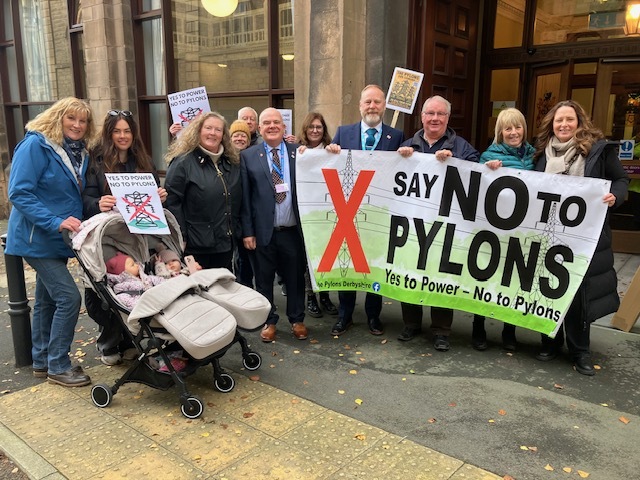
Derbyshire County Council has agreed to oppose National Grid’s current plans to roll-out 60km of 50metre high electricity pylons across the county’s countryside and to urge the energy company to reconsider the route and explore less intrusive alternatives.
The Reform-UK controlled county council voted in favour of taking a stance against National Grid’s proposed Chesterfield to Willington pylon scheme in its current form during a recent meeting after Stop the Pylon Derbyshire protesters had held a demonstration outside the authority’s HQ, in Matlock.
Despite National Grid’s aims to introduce cleaner and cheaper low carbon energy with the scheme alongside claims that most farming can continue around the infrastructure, many councillors have raised concerns about the potential visual impact, disruption and feared damage for the countryside.
Reform UK Councillor, Martin Bromley, who represents Swadlincote East, said: “As we all probably know National Grid proposes to run a line of pylons – or should I say super pylons – from Chesterfield in the north to Willington in the south of our county.
“Along the way, decimating our beautiful countryside and threatening to destroy our communities. We are not against upgrading the power infrastructure, we just want it doing in a better way.”
Cllr Bromley, who brought a successful motion for the council to take a stance against National Grid’s current plans and for the company to explore less intrusive alternatives, suggested the use of underground cables which he says the energy company has so far dismissed due to costs.
He added: “We are already having our greenfield sites designated as grey belt, we already have the threat of major solar installations covering our greenfields, we are already being bombarded with the threat of battery storage installations industrialising our greenfields.
“Now we are facing the threat of super pylons tearing through the heart of our countryside. Derbyshire and especially our countryside are under attack. Under attack by our very own Government.”
Campaigner Kath Hardman, of Stop The Pylons Derbyshire, which held a demonstration outside the council’s County Hall before the council meeting on December 10, has argued the scheme represents an unacceptable industrialisation of Derbyshire’s countryside, serving national transmission needs but offering very little benefit to the communities it will severely impact.
National Grid Electricity Transmission has stated it is proposing to enhance the electricity network by building and operating a new overhead electricity line between a new 400 kilovolt substation at Chesterfield and the existing Willington substation in South Derbyshire with a 60km long scheme with 164ft tall pylons to help meet the challenges of climate change by producing less harmful energy.
A National Grid spokesperson has said the Chesterfield to Willington proposals will support the country’s energy transition and make sure the grid is ready to connect to more sources of low carbon electricity generated in Britain.
National Grid argues the project will transport clean energy from the North of England to homes and businesses in the Midlands and play an important role in building a more secure and resilient future energy system.
Conservative Councillor, Wayne Major, proposed urging National Grid to place the cable underground but this proposed amendment was voted against and defeated after Council Leader, Cllr Alan Graves, argued that to simply ask for underground cables would limit and restrict the general request for ‘less intrusive alternatives’.
Cllr Major, who represents Sandiacre and has expressed concerns about the pylon scheme, said: “The monstrosity – as it is described – goes through my division as well and I share all your concerns and it is a great piece of countryside that is a very valued buffer between the cities of Derby and Nottingham that is enjoyed by residents and visitors who come for walks.
“And you are right these are not normal pylons. These are ginormous individual things.”
Fellow Conservative Councillor, Carol Hart, who represents Breadsall and West Hallam, raised concerns about the possible impact from the planned pylons on rural communities and she described the Stop the Pylons group as ‘absolutely fantastic’ and she urged people to support the campaigners.
Green Party Councillor, Rachel Hatchett, who represents Alport and Duffield, also supported Cllr Bromley’s motion.
She said: “Obviously it’s national infrastructure programme. It is not one that is in the control of any of the local authorities.
“It’s unfortunate that the National Grid is a privatised company driven by profits and the demands of shareholders rather than what is right for the country.
“The upgrade is needed both in Derbyshire and across the country because we need a transition to cleaner and cheaper energy.
“The problem is that the current grid constructed to take electricity throughout the country from old fashioned power stations is not fit for the future. So we need to do something about it.”
However, she argued it was important for National Grid to consider all the construction options including burying the cables underground although she conceded this too can involve damaging trenches and longer term safety issues.
The scale of the project means the final decision about whether it goes ahead or not does not lie with any local planning authorities but concerned parties including councils have already been involved in the first round of consultations.
Derbyshire County Council’s previous Conservative administration raised objections to the scheme in September, 2024, during the first round of consultations and the next public consultation on the project is anticipated in early 2026 when National Grid will publish more detailed plans with a Preliminary Environmental Information Report.
The energy company will have to apply to the Planning Inspectorate for a Development Consent Order and the Planning Inspectorate will make a recommendation to the relevant Secretary of State who makes the final decision.
It has begun developing further proposals informed by an ongoing survey and assessments and the next stage of consultations is expected to take place in 2026.
Originally an application was expected to be submitted for consideration by 2026 and if it is eventually approved construction could get underway by 2028 with an estimated, completed operational date in 2031.
National Grid has stated it wants to work with communities and stakeholders as it considers value for money for bill payers, the impact on the community and environment, planning policy, licence obligations and net zero targets.
A National Grid spokesperson said: “This project is essential to connect the Midlands to cleaner, home-grown energy from more affordable sources, supporting jobs, regional growth and energy security.
“The final route has not been confirmed but following our first consultation in 2024 we have been carefully considering feedback and developing more detailed proposals which we aim to share in early 2026 and seek further feedback.
“We understand the importance of farmland and rural communities. Most farming can continue around infrastructure, with only the land directly beneath each pylon permanently affected.
“Nature protection is built into all our projects from the start with a commitment to leave the environment in a better state than we found it, including creating lasting benefits for wildlife and habitats.
“We will continue to work closely with local communities and stakeholders, including Derbyshire County Council and Natural England to ensure our proposals reflect care for the environment at every stage of the project.”
The county council formally voted in favour of opposing the Willington to Chesterfield pylon route in its proposed format and to call on National Grid to reconsider the route and explore less intrusive alternatives.
They also voted to call on National Grid to be made liable for the upgrading costs and to call on the Secretary of State for Energy to personally intervene in the matter.
The council also voted to work with local campaign groups and affected borough councils to amplify community voices and to request a full environmental impact assessment and a public inquiry before any planning approval is granted.