

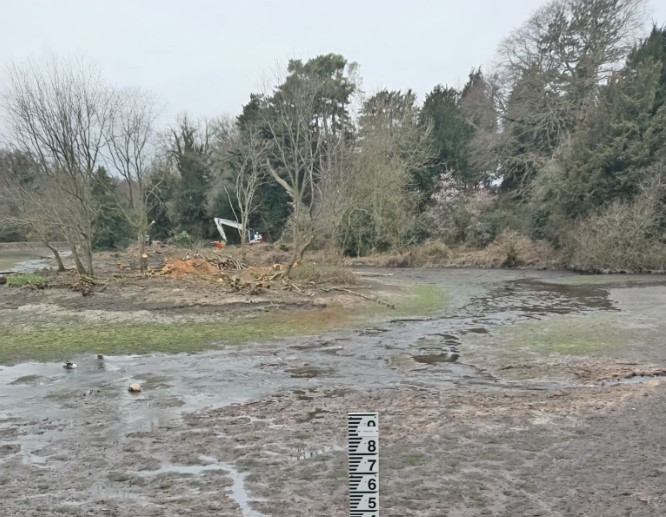
Pictured Earlier In 2026 Is Drained Mill Pond One, At Pleasley Vale Business Park, Which Has Been Undergoing Desilting As Part Of Enviornemntal And Flood Mitigation Works. Courtesy Of Mansfield Wildlife Rescue.
Report by Local Democracy Reporter – Jon Cooper
A Derbyshire council has urged well-meaning residents not to feed wildlife during an ongoing £1.5m project around Pleasley Vale Business Park which aims to reduce flood risks and ensure future wildlife thrives around the site.
Bolsover District Council, which manages and owns the site as a landlord, is overseeing a revised scheme of river and millpond environmental and flood mitigation improvements at the business park, at Outgang Lane, Pleasley Vale, to protect its historic mill buildings from flood water and to carry out further urgent investigative works to mill pond dam walls and culverts.
But after the second phase of work got underway including desilting works to remove sediment deposits in Mill Pond One and Mill Pond Two, the Mansfield Wildlife Rescue charity raised concerns for wildlife after Mill Pond One was drained earlier in the year during the the peak breeding season for birds, swans and ducks and the migratory season for toads and newts.
However, the council – which acknowledges that disruption to habitats has caused distress – says it is working with partners to mitigate potential damage to the habitat and environment and it has urged people not to feed the wildlife so they can leave the area naturally and that wildlife is not to be released into the mill ponds if they have been rescued from elsewhere.
A council spokesperson said: “During the works, feeding wildlife can encourage animals to remain close to the works site. To support their safety and wellbeing, we kindly ask that wildlife is not fed so they can move away from the area naturally.
“The council also asks that wildlife is not released into the mill ponds if they have been rescued from elsewhere. There are laws around moving animals to new habitats and no one should be placing wildlife into the mill ponds at any point.
“The council is working with experts to ensure the disruption is kept to a minimum and that the future of the ponds, and its inhabitants, is healthy.”
Bolsover District Council has a legal responsibility to maintain the site and water course for safety reasons because it features two mill ponds and culverts which sit online and offline to the River Meden with water flowing through culverts which pass under three mill buildings.
It stressed that damage was found to the culvert structures, dam walls, mill ponds and structural concerns were raised with Mill Pond Two’s dam wall and Mill Three’s culverts and the accumulation of silt has been placing a further strain on the mill’s structure as well as posing a flood risk to blocked and deteriorating culverts.
These issues have been compounded by heavy winter rainfall, according to the council, and work needs to take place during the spring and summer to avoid further damage during autumn and winter when work crews would also face greater safety risks with higher water levels and reduced space.
The business park suffered significant damage during Storm Babet in October, 2023, and businesses at the park’s Mill One building were also asked to temporarily vacate the premises in October, 2025, while work continued.
However, Mansfield Wildlife Rescue highlighted in March, this year, that with water removed during the restoration works waterbirds have lost their natural food sources, including aquatic plants, snails, insects and small fish and it raised concerns about the timing of the work during the migratory season for toads and newts and the breeding season for the birds, swans and ducks.
The charity raised concerns that ducks and swans were also being forced to forage on land increasing their vulnerability to predators with a greater risk of malnutrition rising during further disturbance while contractors cleared vegetation.
But the council has stressed the project will protect businesses and residents from the impacts of extreme weather and improve the biodiversity of the site in the long-term by protecting it from floods while improving access for outdoor education and recreational activities alongside a long-term plan to ensure future wildlife thrives around the site.
A council spokesperson added: “Bolsover District Council acknowledges there will be disruption to habitats, and this has caused distress to users of the area. The council has taken all necessary steps to ensure this disruption is short term and temporary.
“The council has worked with Derbyshire Wildlife Trust, The Environment Agency, A2 Maritime and P&D Environmental to time the work to ensure habitats can be protected where possible and that all work undertaken complies with UK wildlife legislation.
“This has included supervision of sensitive elements of the work by ecologists to protect nesting birds, roosting bats, and amphibians and Derbyshire Wildlife Trust will continue to work with Bolsover District Council for the duration of the works.”
The council says fish have been removed under an Environment Agency permit with coordination with the Environment Agency fisheries team and they have been relocated downstream at a pre-agreed location.
Habitat restoration will also take place around Mill Pond One once the scheme is complete, according to the council, and after the construction of a new dam wall, the area will be backfilled with topsoil and carefully seeded with British native plants.
The council says that after the mill ponds have been desilted and restored they will provide a richer habitat for aquatic wildlife and for plants and animals supporting a broader spectrum of species and contributing to a diverse ecosystem with improved water clarity helping more sunlight to reach the bottom and encourage better growth for aquatic plants.
These plants will in turn provide nourishment, oxygen, and shelter to wildlife, according to the council, and the works should also increase the pond’s ongoing resilience and all the work will promote a healthier, more vibrant ecosystem within the mill ponds.
Bolsover District Council stressed it has invested more than £1.5m to complete the vital works and to ensure the flow of water throughout the site which is managed by the council and lies between Bolsover and Mansfield on a floodplain with a flood threat posed by the River Meden.