
Report by Local Democracy Reporter – Eddie Bisknell
Work has started on a 20-year plan for new villages, towns, roads and city extensions across Derby, Derbyshire, Nottingham and Nottinghamshire.
The East Midlands Combined County Authority has umbrella-style planning powers which will now see it outline broad areas for new villages, towns and urban extensions.
This also includes new “strategic” infrastructure such as new link roads, vast new business space and earmarking cross-border development across county and city lines.
The “spatial development strategy” would cover a 20-year period, cost £1.6 million per year – £4.8 million across three years – plus a non-specified sum for hiring staff to carry out the work, and would come into force from 2028.
Step one in the complex process will be to compile the existing housing and business plans that the districts, cities, and counties already hold or are in the process of developing, along with a wide range of additional evidence-gathering.
This will all occur over the years in which the 19 district, borough, city and county councils are all set to be scrapped and replaced with a smaller number of councils – with four being the majority preferred choice across the Derbyshire and Nottinghamshire area.
This change is set to take place in April 2028.
The new umbrella plan across the two counties and two cities comes after a new law received final sign-off in December last year.
It says these new plans will “look across multiple local planning authorities for the most sustainable areas to build and ensure new infrastructure is also being planned for, to support the delivery of new housing”.
The umbrella plan will look at “large regeneration opportunities such as former power station sites, the Freeport and Investment Zone, and town, city centre, and rural renaissance”, but crucially, will not identify specific sites, which is for the councils to decide.
This new plan will also look at areas which need environmental protection, climate change mitigation, biodiversity improvements and employment expansion – at a “strategic” scale only.
A report on the issue says the plan will build on the authority’s existing aims, set out by East Midlands’ Labour Mayor, Claire Ward, in May last year.
This includes an aim to create 100,000 new jobs, deliver 52,000 new homes and add £4 billion to the UK economy.
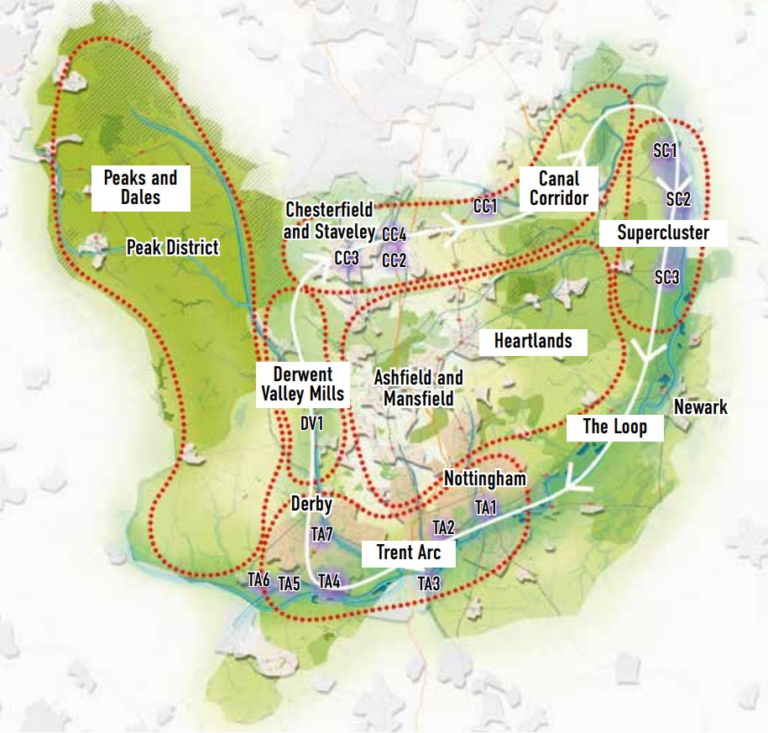
That series of aims includes development in and around Derbyshire and Nottinghamshire’s defunct power stations, existing business investment zones, its city centres, Chesterfield town centre, the Chesterfield to Staveley canal corridor including Worksop and Retford, the East Midlands Freeport, Derwent Valley Mills and the Peaks and Dales.
Last year the “Trent Arc”, the combined area of Derby and Nottingham and their immediate surroundings, was outlined as a prime location for a new town with more than 30,000 homes, along with 40,000 jobs and 2.7 million square metres of commercial floorspace.
That plan says the new town will focus on “growth opportunities linked by three Midland Mainline railway stations – Derby, East Midlands Parkway and Nottingham”.
Upgrades to Junction 24 of the M1 and other public transport routes would be key to supporting this, it says.
Another core project is the “supercluster” of three former power stations along the River Trent in Nottinghamshire, Cottam, High Marnham and West Burton, which are to be at the forefront of clean energy development, including fusion, nuclear and hydrogen power.
It is hoped this can also lead to 6,500 new homes and make the area a “global commercial destination” with a “discovery centre”.
Both the supercluster and Trent Arc were the handpicked investment opportunities the combined authority, through the Mayor, showcased at the annual international business summit MIPIM, held in Cannes, France, in March.