

Report by Local Democracy Reporter – Eddie Bisknell
Private landowners owe a Derbyshire council £100,000 over emergency tree works they failed to carry out themselves.
In the past couple of months, from November through January, Derbyshire County Council has taken action to chop down hazardous trees suffering from ash dieback, with more work set to continue until the end of February.
This includes action on trees on private land which landowners have failed to maintain and take proactive measures to fell.
The county council has told the Local Democracy Reporting Service that it is set to invoice these landowners for £100,000 worth of work and says it will pursue this money with legal action if necessary.
In addition, the council is owed £130,000 from private landowers who have agreed upfront for the authority to carry out felling work on their behalf and to bill them afterwards.
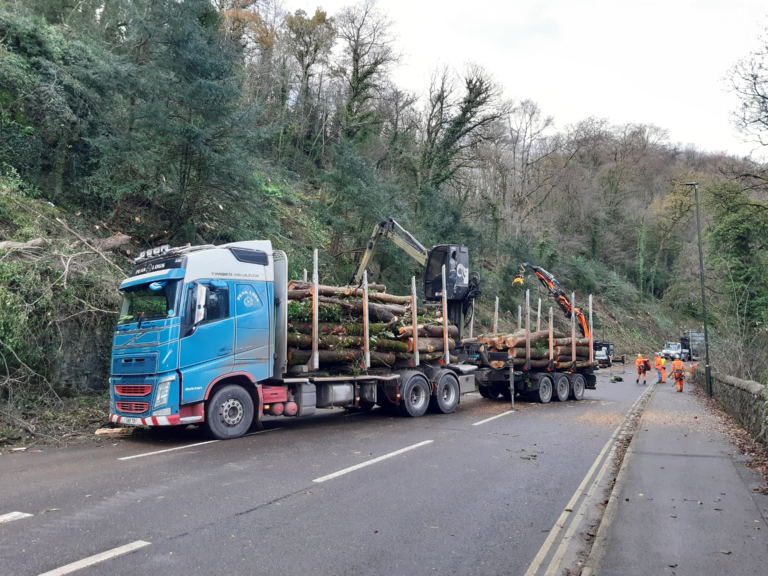
The £100,000 works relates to the stretch of the A6 between Cromford and Matlock Bath involving the “emergency” felling of 100 trees in late November.
This, the council says, followed a tree falling down during Storm Claudia and crushing a car being driven by 25-year-old paramedic and mum-of-three Natalie Bowler, from Wirksworth, leaving her injured.
It said this was the third tree to fall on the same plot of land within a “matter of days”.
Specialist machinery and contractors were brought in to work “at pace” to clear trees from a steep bank alongside the A6, while the winding road was closed for five days.
Meanwhile, the council is set to close the Via Gellia road (A5012) between Cromford and Newhaven from Monday, January 27 until the end of February, on both private land and plots owned by the authority, to fell all ash trees within 20 metres of the route.
This is work which council contractors will carry out on behalf of private landowners, with their prior agreement and promised payment, and for the authority itself.
A council spokesperson said: “When we become aware of trees at risk of falling onto the road or a public footpath we will write to the landowner where we are able to establish the registered owner for the site.
“If there is no response to our letters, we can issue a legal notice informing them of their duty to remove the trees and if action isn’t taken, we may remove them ourselves and seek to reclaim the cost from the landowner under the council’s statutory powers.”
Asked how likely it is that the landowners pay their invoice, a council spokesperson said: “We already have agreements in place with some landowners who have agreed to pay us to remove diseased trees on their land and we hope that as more landowners become aware of the risks from ash dieback they will monitor their own land and deal with any issues themselves so that we won’t need to be involved.
“Legal action is always an option which can be considered when the council is in the position of needing to reclaim costs, but we would always hope to settle without resorting to legal action.”
The council has detailed plans to spend £2 million felling trees affected by ash dieback over the next financial year, followed by a further £1.8 million the year after, with the illness expected to infect between 50 per cent and 90 cent of the ash tree population over the next 10 to 20 years.
Ash dieback kills trees, the council says, “making them brittle and unstable, leading to the potential for a huge number of trees to fall, posing a risk to public safety”.
Cllr Carol Wood, the council’s cabinet member for net zero and environment, said: “Ash dieback disease is a serious problem. It’s a relatively new disease that has spread very quickly and is now present in most parts of the United Kingdom. Ash is currently the second most common tree found in Derbyshire.
“We’re making good progress in tackling trees on our own land which pose a danger to public safety due to this disease.
“Trees on private property are the responsibility of the landowner and they should monitor ash trees for symptoms of ash dieback.
“If a tree on their land were to injure someone or cause damage to property then the landowner would be liable. So taking steps themselves early on not only reduces the risk but means they’re in control of their own costs too.
“If through our routine inspections we’re aware of trees on private property causing a risk to public safety on a road or public path, we’ll try to liaise with the landowner and ask them to remove them. If action isn’t taken, we may remove them ourselves and seek to reclaim the cost from the landowner under the council’s statutory powers.
“We’ll make it clear where we intend to carry out work on behalf of private landowners and will charge them for doing so. The council has established procedures in place to reclaim costs which we would always hope to settle without resorting to legal action.”