

Report by Local Democracy Reporter – Jon Cooper
High Peak Borough Council’s Green Party councillors have stated that alternative methods of reducing carbon emissions from cement and lime industries should be considered ahead of agreeing to Peak Cluster’s proposed ‘£59.6m’ underground carbon capture storage pipeline scheme.
Peak Cluster Ltd, which is made up of cement and lime producers in Derbyshire and Staffordshire, aims to remove carbon dioxide from four cement and lime producers across sites in Buxton and in the Hope Valley, in Derbyshire’s High Peak, and near Cauldon, in Staffordshire, with an underground pipeline.
The scheme, which is subject to a current second consultation, has so far attracted opposition from Derbyshire County Council and Action Against Carbon Capture campaigners as well as over 5,500 responses during its first consultation.
In a joint statement, High Peak Borough Cllrs Joanna Collins and Charlotte Farrell, who represent Hope Valley, said: “We believe the best way to reduce carbon emissions from the cement and lime industries is reduced demand, alternative building materials, reusing buildings, and new cement technologies, not carbon capture and storage.
“We know some people would like us to say ‘yes’ or ‘no’ to Peak Cluster. But the decision will not be made locally.”
Cllrs Farrell and Collins have pointed out that if the Government gives the scheme the go-ahead there will be ‘significant welcome’ carbon emission reductions’ but they have called for the highest standards during and after construction including the need to observe health and safety for communities while avoiding environmental damage.
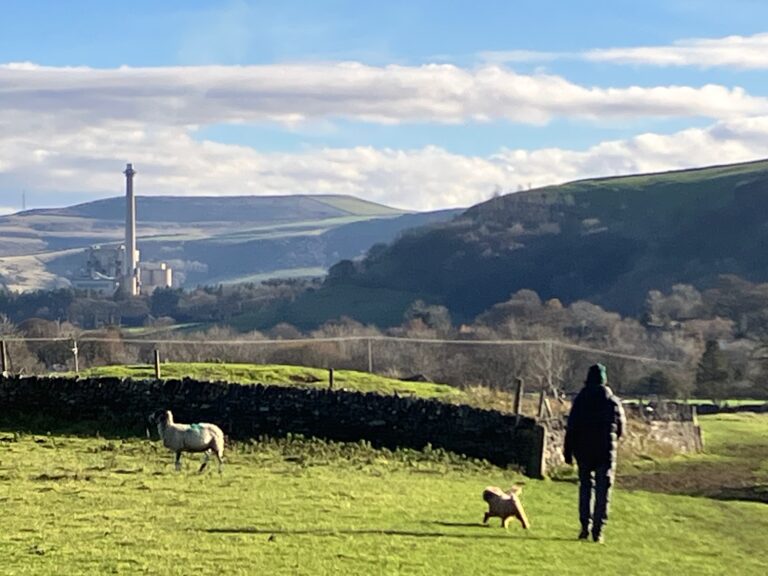
Proposed work plants include: Buxton Lime’s Tunstead lime plant, at Tunstead Quarry, off Waterswallows Rd, in Buxton; Breedon’s Hope cement plant, at Pindale Road, in the Hope Valley; Tarmac’s Tunstead cement plant, at Waterswallows Road, Tunstead House, in Buxton; and Holcim’s Cauldon plant between Cauldon and Waterhouses villages in Staffordshire.
The scheme aims to take CO2 from the connecting cement and lime plants and quarries to a proposed Morecambe Net Zero carbon storage site beneath the Irish Sea beyond The Wirral after passing through Derbyshire, Staffordshire, Cheshire, and Merseyside to secure the industry and reduce carbon emissions.
Peak Cluster stated the project aims to secure the future of Britain’s cement and lime industries while safeguarding and creating jobs and ensuring a reliable, ‘homemade’ supply of essential materials while greatly reducing harmful carbon emissions.
But Reform UK-controlled Derbyshire County Council formally voted in March by a majority to oppose the plans due to safety concerns while it continues to support quarries and the cement industry to secure Government funding to reduce emissions at source.
Independent Derbyshire County Cllr Ruth George argued carbon dioxide is an asphyxiant – or a gas that can cause death – and the proposed Peak Cluster pipeline aims to run across hills, valleys and land that she claims is unstable.
She highlighted a CO2 pipeline rupture in Mississippi in 2020 which she says was caused by soil movement after heavy rain which resulted in people collapsing and needing hospital treatment.
Cllr George argued the proposed pipeline route targets greenfield sites and it will have a significant impact on nature, breaking up wildlife corridors, uprooting trees and hedges along the route and disrupting protected species.
But Peak Cluster CEO David Parkin has outlined the scheme’s safety and environmental benefits and insisted that the pipeline will be as safe as all other major pipelines around the country.
He said: “There has been no major accident on any UK pipeline and we are working within the exact same regulations and standards and we have confirmed it will deliver a safe pipeline.”
The UK currently has about 20,000km of similar underground and unnoticeable steel pipelines for gas, fuels and chemicals, which, according to Mr Parkin, have been operating for decades with a huge reliability and safety without causing any environmental damage.
But Action Against Carbon Capture Storage has raised concerns about disruption and the feared impact on farmland, biodiversity, countryside and The Wirral coastline.
Mr Parkin said similar land has already been used safely for pipelines and he stressed CO2 will be put through the Peak Cluster pipelines at a much lower pressure than in Mississippi with a safer regulatory system and emergency plans.
He stressed strict checks and precautionary plans will be in place in the unlikely event of an emergency and he described any such risks ‘infinitesimally small’.
Peak Cluster has stated that cement production is responsible for 7.5per cent of global CO2 emissions but it claims its plans will prevent over three million tonnes of CO2 from entering the atmosphere each year while strengthening the industry’s resilience and opening up new opportunities for growth.
Green Party County Cllr Lian Pizzey previously pointed out that carbon capture schemes can be very expensive requiring significant amounts of public money which he feels could be better prioritised.
Peak Cluster aims to submit a Development Consent Order application in 2027 for Government approval.
The Government has agreed to award £28.6m towards the estimated £59.6m project to support clean energy and jobs with the remaining funding to come from private firms, according to the Planning Inspectorate.
Labour County Cllr Anne Clarke acknowledged there is a need to balance community concerns and the future of the cement and lime industry and job security while suggesting that other technology should perhaps be ‘scaled up’ to address concerns over carbon emissions.
The latest consultation runs until December 18 inviting comments on affected areas and proposed Above Ground Installations, Block Valve Stations, and temporary areas required for access and construction.
Those interested in the consultation and registering to attend events or webinars can visit www.peakcluster-consultation.co.uk.
A further consultation on more detailed aspects will follow in summer 2027 with more detail on the design, construction and operation.