

Report by Local Democracy Reporter – Eddie Bisknell
A sculpture dubbed a “racist and offensive caricature” will be returned to public display, but will not go back to its former home on an historic Derbyshire pub sign.
At a Derbyshire Dales District Council meeting last night (July 14), members voted to rehouse the former Black’s Head sculpture in the Ashbourne Historical Centre alongside a display explaining the item’s history.
This comes six years after its impromptu removal by those fearing the controversial wooden sculpture would be attacked.
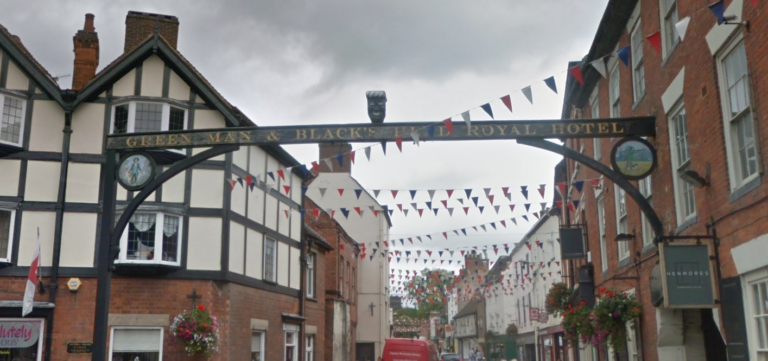
It depicts a black man’s head with a large smiling face on one side, with red lips and a sad face on the other, wearing a red, white and blue striped hat.
The head had formed part of the 18th-century Grade-II*-listed pub sign above St John’s Street in Ashbourne, connected to the now former The Green Man & Blacks Head Royal Hotel – now renamed The Greenman pub.
Rival petitions calling for the sculpture’s removal (45,000 signatures) and retention (4,000 signatures) were started in the summer of 2020 during an international movement questioning the history of statues, largely focusing on their links to slavery.
On June 8, 2020, protesters who feared the black head sculpture was to be removed and destroyed, aided by a number of councillors, removed the head from the listed pub sign.
It was hidden by Councillor Stuart Lees – who is now Conservative Group leader on the district council – in his home for four days, before being returned to the district council, its legal owner.
Since the incident, the head sculpture has been kept in Derbyshire County Council’s Matlock Records Office for six years “for safekeeping”.
Councillors have now retrospectively approved the removal of the head and agreed that it will not be reinstated.
This followed reports from conservation officials who felt that while the default policy is to “retain and explain”, the risk of the head being re-removed and potential damage to the listed structure was felt to be too high.
It was agreed that, in line with other “contested heritage” items, the head would be retained on public display but in a less prominent spot with ample explanatory information.
Dawn Lewis, a member of the public, had told the meeting that her family history in Ashbourne stems back to the 1700s and felt strongly about the town’s history, saying: “Sadly we are now living in a world where people shout ‘I am offended’. Even if they are in the minority, we have to change our ways as a result.
“I object to people of no real affiliation with Ashbourne making a decision over what is to happen to the head.”
She said she was “deeply offended” at allegations that Ashburnians are “racist”, saying: “We should not bow down to the few.”
Graham Elliott, a further resident, said the Black’s Head was an “iconic part of the streetscene for over 200 years” and said it was not seen as racially offensive until “a keyboard warrior started a petition”.
Councillor Robert Archer, one of the town’s district councillors, and also a history teacher, said: “History should be learned from and not erased.
“While I completely accept that this artefact may not have been intended to be racist or offensive and also that the people that want it back up are not racist, the origin and history of it is disputed and unclear.
“What is clear is that the design and style of the head is certainly concerning in a modern context.
“It is understandable that it is regarded as offensive and upsetting by many in the black community and the many non-black residents who I have spoken about this to.”
He said that following millions of pounds of improvements to Ashbourne “to place the Black’s Head back on the gallows sign… would I believe be a backwards step and would damage the reputation of the town just as it is being seen as a great place to visit again”.
He said he would advocate for a green man’s head or a Shrovetide football to be placed on the remaining sign in the future.
Councillor Gustav Clark, a member of Ashbourne Town Council, said: “In an ideal world in which there were no problems of racism or activism, activism mainly, I think the district council would have voted for keeping it on the gantry. The problem is we are not in an ideal world.”
Ashbourne resident Sandra Spencer said councillors should “Stop pandering to the likes of one person who started this uproar when there was no need to.”
Martin Spencer, a further resident, said: “It would be a bad reflection on all of us if in the 21st century we cast aside this important heritage to be lost forever.”
Cllr Lees claimed the head had never been associated with any sort of racism and was of “significant historic importance”.
Meanwhile, Councillor Dermot Murphy (Con), said: “Many people want it back in situ.
“I don’t believe it was put up originally to ridicule anybody or mock anybody, it was put up without any concerns that it would not be palatable
“We should not sanitise history just to please some people.”
Councillor Peter Dobbs (Lib Dem) said: “The suggestion is that everything was fine before the petition, it was not. I don’t think it will really help Ashbourne to put it back up. This is not something that actually does justice to the town.”
Jo Linthwaite (Lib Dem), civic chair of the council, said the dictionary definition for caricature included that it was to exaggerate features at the expense of the subject.
She said: “As I child I loved my golly (golliwog, a formerly popularly black rag doll), but would I retain that naivety today? No, I wouldn’t. It is a part of Ashbourne’s history but it is a grotesque caricature.”
Councillor Neil Buttle (Gre), co-deputy council leader, said: “I think it is time that we move on from this sort of thing and it reflects poorly on Ashbourne and I think putting it in an historical context is a good way forward.”
Councillor David Hughes (lLib Dem), said: “The issue isn’t whether Ashbourne is racist or whether there was racist intent but that it is a caricature and it in its own right it can be racist. “Black minstrels had similar features but they are not on TV anymore. The minstrel caricature is viewed as racist and this is a racist image and that is what concerns people.”
Councillors approved the removal and relocation of the Black’s Head by a vote of six votes in favour, two against and one abstention.
The people who removed the sculpture were photographed and filmed throughout the removal on June 8 and their identities were uncovered.
They were part of a group of around 150 campaigners who gathered to remove the sculpture.
Cllr Lees had been identified as hiding the sculpture in his home. There was “resistance” to the sculpture being kept safe in the district council’s Matlock headquarters, which led to a four-day delay in it being returned by Cllr Lees between June 8-11.
The district council had agreed to remove the sculpture at 5am on June 9 to protect it from potential vandalism but before this could happen, at 9.43pm on June 8, protesters removed it, watched on by three district councillors and three town councillors.
Then council leader, Cllr Garry Purdy, had called district council chief executive Paul Wilson during the gathering of the crowd in St John’s Street, agreeing to remove the head “to defuse the situation and avoid the risk of damage to the sign”.
Cllr Thomas Donnelly, also district councillor for Ashbourne, arranged for the safe removal of the head alongside Cllr Lees, who, due to their joint background as firefighters, are said to have overseen the secure positioning of ladders, the investigation had found.
Cllr Robert Archer had claimed the motive of the crowd was to stop the head “falling into the hands of its owner, the district council” and not to prevent it from being vandalised.
Steve Dunning, the council’s appointed independent person, who carried out the independent investigation for the council, had found “no evidence of any direct threat at that time, from anyone to remove the head or threats of vandalism”, but had said “it was fair to assume” there was a “perception” of a potential risk to the head sculpture.